
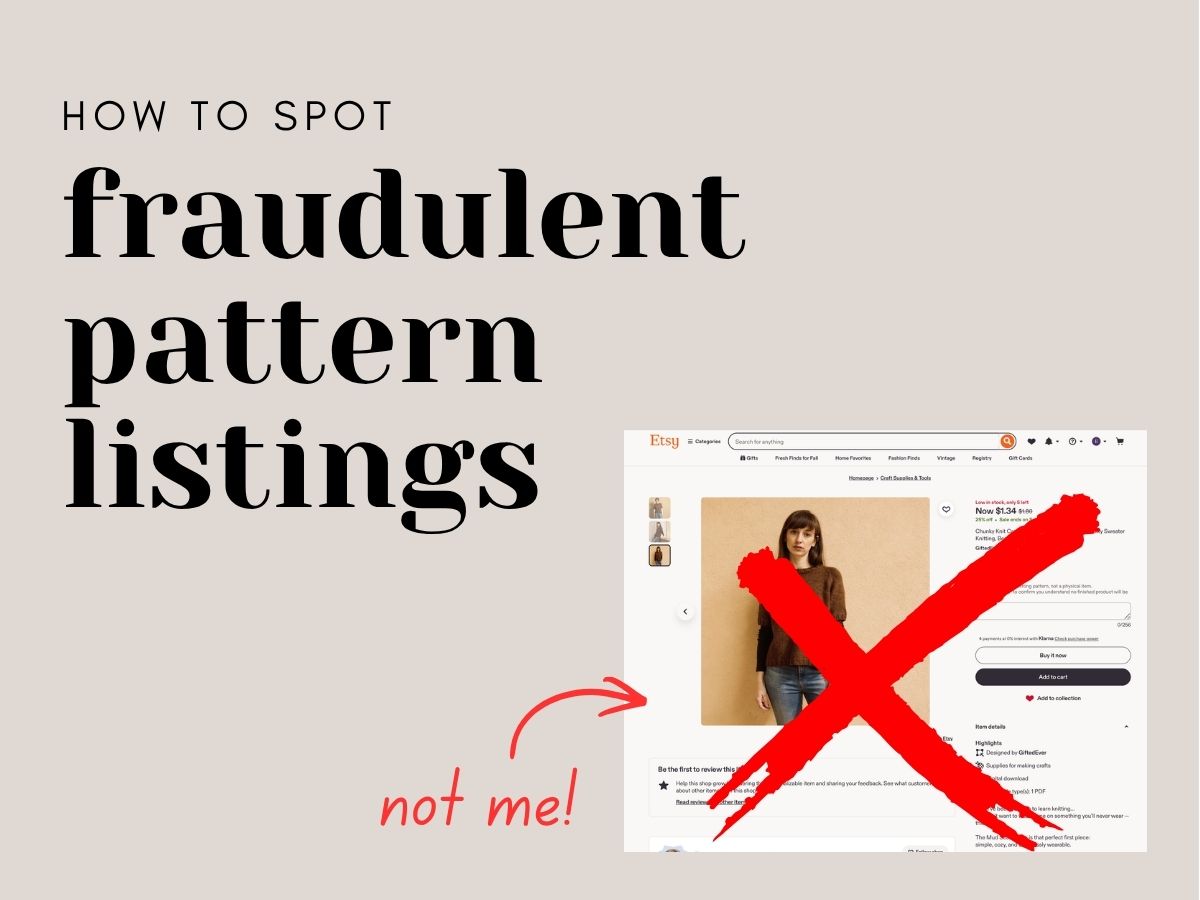
Unfortunately, I’ve seen quite an increase in fraudulent knitting pattern accounts online. So I wanted to share some tips to help you make sure the knitting pattern you see marketed online is actually the designer’s pattern and not a fraudulent listing. And I’ll share some examples of how my photos/work have been stolen so you can see real-life examples.
What are fraud accounts/listings?
Here’s what’s happening: Fraudsters can steal a designer’s photos and pattern instructions, alter the images using AI and then sell the pattern as their own. Besides the obvious issue of theft, there’s also no way to know whether the pattern instructions they’re selling are even accurate.
I’m not talking about designs that simply look similar. I’m talking about accounts created specifically to steal designers’ photos and patterns and resell them. Or they steal the photos and sell incorrect patterns (or who knows what they’re actually selling!), deceiving the purchaser. And as AI becomes more advanced, these fraudulent listings can be harder to spot.
Below are just two examples of how my work has been stolen and posted as listings on Etsy (a site I’ve never sold on, by the way).
Example 1: Mud Season
Mud Season is one of my patterns that gets stolen frequently, most likely because I offer it for free (so unfortunately scammers have taken advantage of that). Here are some actual photos from my website and Ravelry pages:


And here are two recent fraudulent Etsy listings:


In the first, they straight up stole some of my photos but added the “PDF Pattern Eng” text next to it. And they even left the “Mud Season” name in the title. And they’re trying to make money off of it (whereas the original is free). So this is an example of a very obvious theft.
In the second, they utilized more generative AI. Because…doesn’t the model kind of resemble me (or at least some features) but just a a thinner, more robotic polished looking version? So creepy. But they kept the jeans/undershirt and similar hands (at least my wedding ring). And although they don’t put “Mud Season” in the title, they put it in the descriptor. And they’re also trying to make money from it.
So this isn’t a case of “someone designed a similar looking pattern” because Mud Season is quite basic – I’m sure there are lots of tops out there that look like this. But in this case it’s obvious they utilized my photos and all of the details in the write-up are the same as mine including even the pattern name.
Example 2: Alanis
Here’s another one that I was notified about recently. My Alanis design has been around for quite a while and some of you may even remember the Alanis KAL I hosted a few years ago.
Here are a couple of original photos:


And here is the fraudulent listing and photos posted on Etsy:


This one is especially strange. They completely changed the person wearing the sweater but kept the same undershirt and jeans in some photos, and one particularly telling detail: my necklace. The sweater is a unique design on it’s own, but the fact that the necklace is there makes it obvious they stole my photos and put them through AI. And they’re charging more for the pattern than me!
There are other clues when you compare the listing photos. The different sweater colors, the necklace changes length in some, and the pocket lining detail changes.
So, this all brings me to some things you can look for when you’re trying to determine whether a pattern listing is legitimate. Because as you can see from these photos, it may not be as obvious as it used to be.
Tips for Spotting Fraudulent Pattern Listings
Tip #1: Know where your favorite designers actually sell
This is the most important one. If you regularly purchase patterns from a particular designer, knowing where they officially sell their work can make spotting a fake much easier. For my patterns, I legitimately sell through these channels:
- My personal website: elizabethsmithknits.com
- Ravelry
- LoveCrafts
- Local yarn shops
I have never sold my patterns on etsy.com, so if you see a design that looks like one of mine (or a photo that kind of looks like me!), it is not being sold by me. And so far every fraudulent pattern listing (of my designs) that’s been brought to my attention, have been on Etsy. So it’s worth mentioning so you can be especially vigilant on that platform if it’s one you use to look for patterns. So far, I have not seen any of my photos/designs stolen on Ravelry.
Tip #2: Be a photo inconsistency detective
Right now, AI-generated photos often contain some little inconsistencies you can spot. Although it’s getting harder and harder to tell and I imagine that within just weeks or months, this may not be the case as much.
But one thing you can do right now is look closely at the stitches and construction details. Do they actually look like knitting? Do details change from one photo to another? For example, in the Alanis example, look at the pocket lining detail – it changes photo to photo:

Again, these inconsistencies don’t automatically mean a listing is fraudulent but they can be clues that raise a red flag and tell you perhaps it’s worth investigating a little further.
Tip #3: Investigate the shop itself
Don’t just look at the pattern listing. Take a minute to look at the shop’s profile and About section.
For example, the “About Us” info for the shop selling the fraudulent Alanis describes itself as creating crochet patterns. That doesn’t match the knitting patterns they’re supposedly selling, sooo that’s a red flag.
One of the shops selling my Mud Season pattern is called “GiftedEver.” Its About page has a header that says “Sarah’s Happy Tokens” and references crochet (so again, red flag because they’re selling a knitting pattern), and then gives different names for shop owners (so who’s Sarah?).
Again, an inconsistency like this don’t necessarily prove fraud on its own, but when several of them start adding up, that’s a good reason to investigate further before purchasing.
Also, some shops may have permission to sell another designer’s work (if they have a wholesale agreement), but if they do, they typically will still credit the designer’s name and not try to say the pattern is their own. So the biggest takeaway is simply to look a little closer before purchasing. Check the photos, look at the shop itself, and when something seems inconsistent, see if you can find the designer’s official website or Ravelry page.
In Conclusion…
Unfortunately, fraudulent pattern listings probably aren’t going away anytime soon. But knowing some of the warning signs can help you become a more informed pattern buyer.
Also, if you ever come across one of my patterns somewhere online and something doesn’t look quite right, please let me know. I don’t have the time or resources to fight every single fraudulent listing, but I do file intellectual property complaints whenever I can. And the good news is that so far, whenever I’ve filed a complaint, Etsy has taken down the listing and their turn-around time seems to be getting faster and faster.