
Learning to read knitting patterns can be a tricky process at first. It can sometimes feel like you’re learning a new language; or maybe more accurately, learning a new coding system! But unlike learning, say, HTML, or some other kind of system with a set of established rules, knitting patterns don’t have one absolute industry standard. There are common practices, but many formatting choices are up to the individual designer and can vary pattern to pattern.
One area where you’ll see this is in how parentheses are used to communicate instructions for multiple sizes. And that’s what this blog post is all about!
Whether it’s different sizes for an accessory (like a hat or scarf) or multiple sizes for a garment, parentheses are commonly used to visually organize the size-specific numbers throughout a pattern. The specific format will typically be established under the “Sizes” header on the pattern information page. Let me give you a couple of examples.
A Simple Two-Size Example
In my Sidekick Scarf pattern, under Sizes it says: small (large)

This tells you there are two sizes and establishes the order they’ll appear throughout the pattern when there are size-specific numbers in the instructions. The first number (outside the parentheses) represents the Small, and the number inside the parentheses represents the Large.
From that point forward, whether you’re looking at the pattern information page or the instructions themselves, whenever you see two numbers presented in that format, you’ll know which number belongs to your size. So for example, under the Yarn header, the pattern lists the amount needed as: approx. 200 (430) yards.
That means the Small requires approximately 200 yards and the Large requires approximately 430 yards.
Garment Pattern Example
Garments typically have many more sizes and this is where you’ll see more variability in how different designers use parentheses.
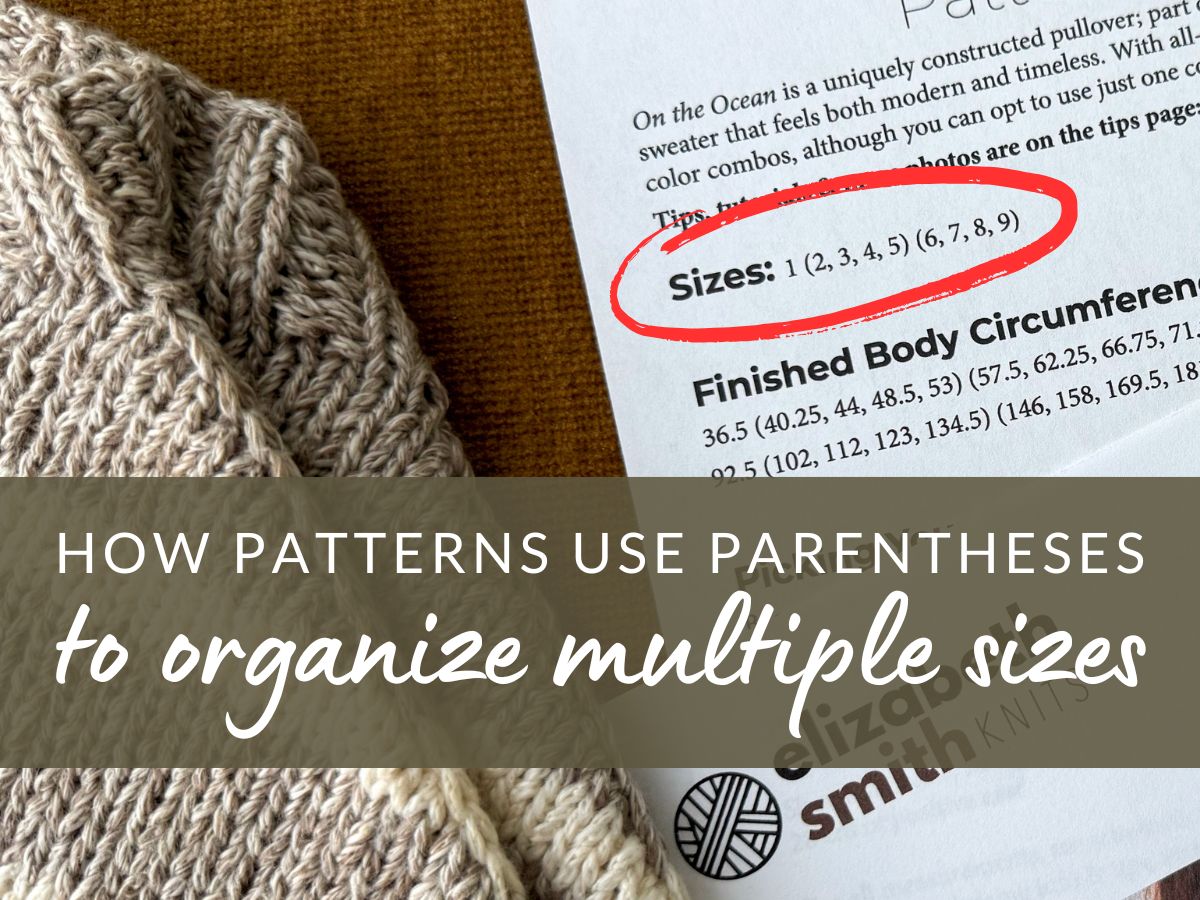
Here’s how I typically do it – let’s use my On the Ocean pullover as an example. Under the “Sizes” header, it says: Sizes: 1 (2, 3, 4, 5) (6, 7, 8, 9).

There are nine sizes total – Size 1 is outside the parentheses, followed by two sets of parentheses with four sizes in each. Why two sets? It’s purely visual. Breaking the sizes into smaller groups makes it easier to quickly find and keep track of your size.
For example, if you’re making size 5 and everything were written as: 1 (2, 3, 4, 5, 6, 7, 8, 9), it would be much easier to accidentally miscount with so many numbers grouped together. But with: 1 (2, 3, 4, 5) (6, 7, 8, 9) you can quickly see that size 5 is always the last number in the first set of parentheses.
And here’s the key: that same order will carry through the entire pattern.
Different Designers, Different Styles
This is where individual designer styles come into play. How many sets of parentheses a designer uses, and how the sizes are grouped within them, is generally a matter of their own formatting preferences.
For me, if a pattern has nine sizes, I’ll typically put sizes 2–9 into two sets of parentheses, with four sizes in each like I showed above. But if I have 10 sizes, I’ll typically divide sizes 2–10 into three sets of parentheses, with three sizes in each.
You may notice when browsing patterns on Ravelry that formatting styles can sometimes vary depending on where a designer is based. For example, I’ve seen this style more often in patterns from European designers: XXS (XS) S (M) L (XL) 2XL (3XL) 4XL (5XL) 6XL.
But the basic idea is the same. The sizes are being visually broken up to make the numbers easier to follow. In this particular style, every other size is placed in parentheses, with only one size listed inside each set.
That’s why the most important thing to do is look at the Sizes section at the beginning of the pattern. It establishes the order and formatting the designer will use throughout the rest of the pattern.
What If There Aren’t Any Parentheses?
So what happens when you come across a number in a pattern with no parentheses at all, but there are multiple sizes for the pattern?
If only one number is given, that number applies to all sizes. This is true whether you’re working from a pattern with two sizes or a garment pattern with many sizes.
For example, in my Sidekick Scarf instructions, it tells you to: “Cast-on 5 sts“. There are no additional numbers in parentheses, so both sizes cast-on the same 5 stitches. The same rule applies in a garment pattern. If there’s just one number listed (instead of a series of numbers for the different sizes), that instruction applies to every size.
What Does an “x” or “-” Mean?
There’s one other situation that’s helpful to know about. Sometimes a particular instruction doesn’t apply to every size. For example, a garment pattern might tell you: “Sizes 1 & 2: Skip the following row.” And the instructions for that row might then look something like this: “knit x (x, 1, 1, 2) (3, 4, 4, 5) sts…”
Sizes 1 and 2 don’t have numbers because the row doesn’t apply to them. The x is simply acting as a placeholder so that all of the other size numbers stay in their proper positions.
You may also see a dash used instead, so it may look like this: “knit – (-, 1, 1, 2) (3, 4, 4, 5) sts…”
It means the same thing…there’s no instruction for those particular sizes, but the placeholder keeps all of the remaining sizes lined up correctly.
The main takaways…
- Parentheses can be a visual tool for organize size-specific numbers in a knitting pattern.
- Although there are common industry practices, there’s no single standard for exactly how designers group sizes within parentheses.
- Always start by looking at the “Sizes” section of the pattern info page. It establishes the order and format used for the different sizes throughout the pattern.
- Once you identify where your size falls in that sequence, look for that same position whenever multiple numbers appear.
- If only one number is given (with no additional size numbers in parentheses), it applies to all sizes.
- An “x” or “-” may be used as a placeholder when an instruction doesn’t apply to a particular size.
I hope this information has been helpful, whether you’re a brand new knitting pattern reader or just have always wondered about the use of parenthesis with sizing. If you have any questions (or perhaps any additional insight I didn’t cover!), feel free to reach out!