
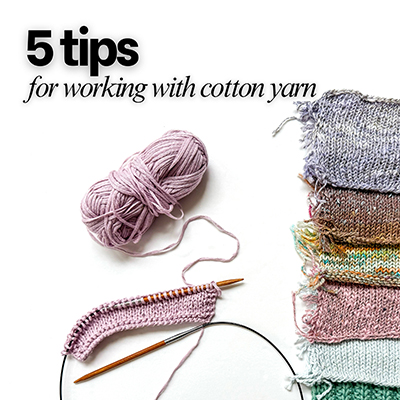

It’s that time of year: cotton yarn season! If you head to your local yarn shop right now, you’re certain to find lots of new arrivals in 100% cotton and cotton blends.
Plant-based fibers are great for warm weather because they pull heat away from the body, tend to be breathable and are often moisture-wicking. But cotton behaves very differently than wool, both on the needles and in the finished fabric. So I thought I would share my top 5 tips as you start thinking about Summer cotton projects!
Tip #1:
100% cotton has very little elasticity – keep this in mind when choosing your project.

What exactly does elasticity mean when it comes to fiber and knitting? Think of it as a fiber’s ability to recover after being stretched.
Wool has a lot of elasticity, so garments tend to spring back and hold their shape well, even after repeated wear. Cotton has very little elasticity so it doesn’t recover in the same way. Instead, it tends to relax and grow with wear.
Because of this, cotton is often best suited for garments where drape is prioritized over structure.
Tip #2:
Although cotton grows with wear, it stiffens during blocking (so don’t be surprised!).

One thing that can be surprising is that although cotton grows with wear, it often does the opposite during blocking! After soaking, cotton fabrics can feel surprisingly stiff and rigid and lose a lot of their drape. Sometimes a wet cotton garment can almost feel like cardboard!
Often people will think cotton yarn will behave like superwash, another yarn that tends to grow. But unlike superwash, with cotton the growth comes with wear, not water. So when laying a cotton garment or accessory flat to dry, you’ll likely need to gently shape and pat it into its finished measurements.
And don’t be alarmed if it still feels stiff once dry. With wear, it will soften right up.
Which brings us to tip #3…
Tip #3:
Shake it out!

After blocking, cotton can feel stiff – kind of like how air-dried jeans feel! Once I remove a cotton piece from the blocking mats, I like to literally shake it out. I find it helps release some of that stiffness and allows the stitches to settle more naturally.
I’ll also often use a hand steamer, which softens the fabric and helps relax the side creases that can form during drying.
And this all goes for swatching too! Once your swatch is dry, don’t measure it right away. Shake it out and, if possible, let it hang overnight so gravity can do its thing. Then measure it – it’ll usually give you a more realistic picture of your final gauge.
Tip #4:
Fiber structure matters (a lot)

When it comes to cotton and cotton blends, fiber construction has a huge impact on how the yarn behaves — both while knitting and later during blocking and wear.
Traditional cotton yarns are usually plied, meaning fibers are twisted together. There can be different degrees of twist (for example, as shown above, Berroco Pima 100 has a tighter twist than Sandnes Garn Line), but both will generally behave like traditional cotton yarns in terms of tips #1, #2 and #3.
But there are also a lot of chainette-constructed cotton blends now, and those can behave a bit differently. Examples of cotton blend chainette yarns, as shown above, are Plymouth Yarn Sea Isle and Juniper Moon Farm Cumulus.
Chainette yarns are constructed as a small knitted tube rather than a traditional twist of fibers. This construction traps air inside the yarn, creating a fabric that often feels lighter, airier and a bit more flexible than you might expect from cotton (learn more about chainette yarns in my blog post here).
Chainette yarns are also usually blends and often contain fibers like nylon or wool which can add a bit more flexibility and recovery. Because of this, they often don’t feel as stiff after soaking or right off the blocking mats (meaning tip #3 may not be necessary). But like traditional cotton yarns, they still tend to favor drape over structure and can still grow with wear.
Tip #5:
You’re more likely to row out with cotton or linen (so try this)

Rowing out refers to uneven tension between rows, where certain rows stand out because the stitches are slightly larger or smaller than neighboring rows. This creates subtle horizontal lines or striping in stockinette.
It often happens because a lot of people’s purl stitches are looser than their knit stitches (mine definitely are!).
With wool, the elasticity and fuzziness of the fiber can help disguise those differences. But with smoother fibers like cotton and linen, uneven tension tends to be much more visible. So on the pro side, cotton yarns provide amazing stitch definition. On the con side, they tend to show every little variation in stitch size.
If your swatch shows signs of rowing out, try using a smaller needle on your purl rows. Tightening those stitches just a bit can help create a more even-looking fabric.
I hope these tips have been helpful as you start to think about those cotton and linen projects this Summer! Do you have any other tips for working with plant-based fibers? I’d love to hear them – reach out here!