
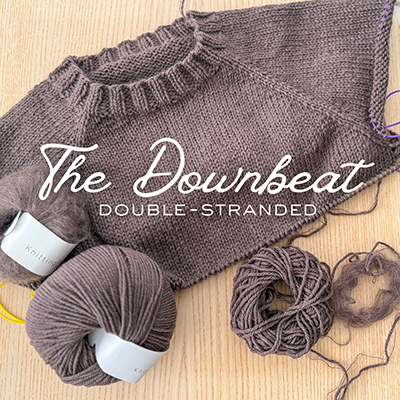

Last fall I released my pattern The Downbeat, a simple top-down pullover knit in one piece using worsted-weight yarn. Short rows are used to shape the neckline, which means there’s no picking up stitches for the neck trim — you work seamlessly from the very top all the way to the hem.
Because of this clean, uninterrupted construction, The Downbeat makes a great blank canvas for experimenting with different yarn choices and fabric textures.
To show that flexibility in action, I recently knit up a new sample by double-stranding a worsted-weight merino with a lace-weight mohair. For this version, I used Knitting for Olive Heavy Merino held together with Knitting for Olive Soft Silk Mohair, both in the color Plum Clay. The yarn was purchased at Olde School Fiber & Craft in Gorham, Maine.


Before diving deeper into double-stranding with mohair, I want to pause and explain the size, fit, and length choices I made for this new sample, and how they compare to my original one.
Sizing & Fit
For this version — which I’ll call the plum version — I knit size 3, which has a finished circumference of 41.5″ at both the bust and the hem (no A-line shaping). I worked the length to approximately 11.5″ from underarm to hem, landing right between the cropped and standard length options.
In my original sample — the green version — I knit size 2 with A-line shaping, resulting in a finished circumference of 38.5″ at the bust and 41.5″ at the hem. I followed the cropped length instructions for that version, making it 10″ from underarm to hem.
Looking at them side-by-side helps make those differences clearer:

In the green version, I’m wearing the sweater with about 4–5″ of positive ease at the bust and 1″ of positive ease at the hips. In the plum version, I’m wearing it with 7–8″ of positive ease at the bust and again 1″ of positive ease at the hips. So in both versions, the hem circumference is exactly the same. But because the green version is A-line shaped, it has a smaller circumference at the bust and feels a bit more fitted through the top. The plum version, with the same circumference at the bust and hem, has a more relaxed and roomy fit on me overall.
The other difference is length. The plum version is 1.5″ longer, which may not sound like much, but it noticeably changes how the sweater works with my wardrobe. The cropped length of the green version works especially well when I layer underneath it, as shown in the photo above. That extra 1.5″ in the plum version, however, makes it work well on its own without layering.
Both versions work — they just create different looks. This is a great example of how multiple sizes can technically fit you, and how choosing between them often comes down to the type of fit you prefer and how you plan to style the finished garment.

As mentioned earlier, the plum version is knit by double-stranding a worsted-weight merino with a lace-weight mohair, so let’s take a closer look at why knitters often choose to work this way.
Why double-strand with mohair?
Why do people opt to double-strand with mohair? There are lots of reasons, but here are a few common ones.
To make the fabric softer and fuzzier
This was my main goal with this version of The Downbeat. The fabric created with just the Heavy Merino would have been perfectly lovely on its own, but adding the mohair introduced an extra layer of softness and a subtle halo. Because that added softness was what I was after, I chose the same color in both yarns.
To add some subtle color variation
Double-stranding with mohair also opens up opportunities for color play. You might choose a mohair that’s just a few shades, tints, or tones off from your main yarn for a subtle color blend, or something more contrasting for a marled effect.
To fill in the gaps in a loose fabric
Mohair is often added when working at a looser gauge. For example, a pattern might call for fingering-weight yarn held together with lace-weight mohair at a gauge of 21 stitches = 4″. On its own, fingering-weight yarn at that gauge would feel quite open, but the fuzzy mohair helps fill in the gaps, adding substance to the fabric while still maintaining drape.
How much yardage do you need if double-stranding with mohair?
In most cases, you’ll need the same yardage listed in the pattern for both yarns.
For The Downbeat, size 3 suggests 1000 yards for the standard-length version. That means you would need 1000 yards of the Heavy Merino and 1000 yards of the lace-weight Mohair.
Because I knit my plum version shorter than the standard length, I used approximately 875–900 yards of each yarn — which worked out to 7 skeins of the Heavy Merino and 4 skeins of the mohair.
If you’re curious to dig even deeper into this technique, I have a couple of other blog posts you might enjoy: